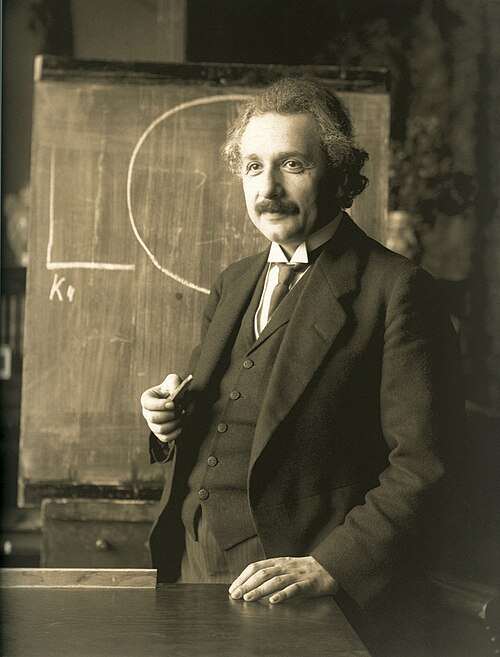
Albert Einstein
A reading of the patterns in how Albert Einstein operates, computed from the placements above. Every line traces back to a chart position. Not a prediction. Same birth data, same report, every time.
A dreamer who does his thinking out where the big questions live
The center of Albert Einstein's chart sits in a quiet, wide-open place. His Sun is in Pisces in the 9th house, the part of a chart that reaches for the largest picture, the laws behind the laws, the meaning under the surface. Pisces is the sign that dissolves boundaries and thinks in images rather than in tidy boxes. Put those together and you get a person whose core identity is bound up with imagining, with following a thread of wonder until it leads somewhere nobody has been.
That soft, imaginative core is carried by a protective outer shell. His Ascendant is Cancer, so the way he meets the world is careful, a little shy, and slow to fully open. Cancer rising tends to hold people at arm's length until it trusts them, then becomes warm and loyal. The ruler of that Ascendant is the Moon in Sagittarius, which means the thing that steadies this guarded person is freedom, humor, and room to roam in his own mind. He needs a shell and he needs the horizon, both at once.
The chart also crowds a lot of energy near the top, in the 10th house, where Mercury, Venus, and Saturn gather in Aries. This is a signature that pushes private imagination out into public work and wants that work to be original. The pattern of the whole chart is a pull between the dreamy Piscean well and the sharp Aries drive to say something new and stake a claim. Einstein reads as a man who lived in his imagination but refused to keep it there, who kept turning inner pictures into things the world could check.
Gentle and guarded on the surface, restless underneath
With Cancer on the Ascendant, the first impression Albert Einstein gives is soft rather than sharp. Cancer rising tends to read as approachable, a bit private, and quietly watchful, the person who takes in the room before deciding how much to show. There is often a homey, unpolished quality to it, a lack of interest in looking slick. People frequently feel they can bring their guard down around this kind of presence, even before they know why.
The ruler of a Cancer Ascendant is the Moon, and here the Moon is in Sagittarius in the 6th house. That gives the guarded surface a surprising streak of playfulness and bluntness. The careful shell opens into someone who jokes, who says the frank thing, who would rather be honest and a little rumpled than smooth. This is the mix that makes a person seem both tender and unbothered by what others expect, warm at the door and independent once you are inside.
Underneath the mild exterior sits a much more driven engine. Mercury, Venus, and Saturn all sit in Aries near the top of the chart, so the inner reality is more impatient and more ambitious than the gentle first impression suggests. People who only meet the Cancer surface can underestimate the Aries push for originality that runs the show once he cares about something. The quiet one turns out to have very firm ideas and a strong appetite to prove them.
The gap between outside and inside is the interesting part of how Einstein came across. The chart describes someone easy to caricature as the absent-minded, kindly figure, while the real interior is stubborn, exacting, and unwilling to defer. A concrete way this tends to show up: the disarming, humble manner is genuine, and so is the refusal to bend on the thing he has actually thought through. Both are true at the same time, and that is exactly what Cancer rising over an Aries stellium looks like.
Thinks in leaps, argues in plain speech
Mercury is the planet of thinking and speaking, and Einstein's Mercury is in Aries in the 10th house. Aries thinks fast, direct, and from the front, more interested in cutting to the new idea than in cataloguing what already exists. In the 10th house, that mind is pointed at the public arena, at making a mark and being heard. This is a person who does not think quietly for its own sake but to arrive somewhere and say it out loud.
There is a real tension baked into how he learns. Mercury sits in impulsive, first-strike Aries, yet Uranus is in Virgo in the 3rd house, the house of the everyday mind, and it is retrograde. Virgo in the 3rd wants precision, detail, and the patient checking of the small parts, while the retrograde turn pulls that questioning inward, so he tests conventional explanations against his own private standard rather than accepting the received version. The result is a mind that leaps to a bold guess and then grinds it against exacting, unusual, self-set logic.
That Uranus placement also explains a famously original streak in how he framed problems. Uranus is the planet of the sudden angle, the idea that arrives sideways, and in the 3rd house of thought and language it tends to produce people who picture a problem instead of only calculating it. This is the imaginative, what-if-I-were-riding-a-beam-of-light style of reasoning, thinking by vivid mental scene rather than by rote. The everyday mind here prefers the strange doorway to the front door.
For voice, the Sagittarius Moon and the Aries Mercury combine into something plain-spoken and quotable. Sagittarius likes the broad, memorable statement and a bit of dry wit, and Aries likes it sharp and unhedged. A grounded way this shows up: Einstein was known for turning enormous ideas into simple, almost stubborn sentences a non-specialist could hold. The chart supports that reputation, a big-picture mind that insisted on saying things in words an ordinary person could carry home.
A private self that needs both a den and an open sky
The emotional core of this chart is a study in contrasts. The Moon, which describes what a person needs to feel safe, is in Sagittarius, a sign that feels safest when it is free, when nothing is fencing it in. But the Ascendant is Cancer, the most home-loving, shell-building sign there is. So the inner world wants a cozy den and an open horizon at the same time, retreat and roaming, and it settles best when it has private space that still leaves room to wander.
That Sagittarius Moon sits in the 6th house of daily routine, which tells you where his feelings went to rest: into the ordinary rhythm of work. For this placement, emotional steadiness comes less from big events than from having a task, a familiar desk, a problem to turn over. The 6th house Moon tends to soothe itself through the daily doing rather than through drama. Feeling useful and absorbed in something is, for him, a form of feeling safe.
The Sun in Pisces adds a deep inner tide that others rarely see directly. Pisces is porous and receptive, given to long private reverie and to a sensitivity that can quietly absorb the mood of a room. Combined with a Cancer Ascendant, it points to someone who feels a great deal and shows only part of it, who processes life inwardly first. There is a solitude here that is not loneliness so much as a need to be alone with the inner picture.
The private need this chart keeps circling is the need to not be crowded. A concrete way it tends to surface: the guarded Cancer exterior can look like warmth while quietly guarding a large inner territory that the person will protect at real cost. Einstein reads as someone who could be affectionate and companionable and still keep an inner room that no relationship was allowed to fully enter. That room, not any particular house, was his real home.
Drawn to the spark, uneasy with the fence
Venus shows how a person loves and what attracts them, and Einstein's Venus is in Aries in the 10th house. Aries in love is direct, quick to be drawn in, and lit up by the chase and the fresh spark far more than by slow-burning comfort. In the 10th house, Venus also links affection to standing and to shared purpose, so attraction and admiration for what someone does can run close together. This is a person who falls fast and toward the exciting rather than the settled.
The way he actually meets a partner is shaped by Mars in Capricorn in the 7th house, the house of committed one-to-one bonds. Mars in the 7th brings heat and a certain contest into close relationships, and Capricorn makes the approach serious, dutiful, and aware of structure. So there is a real pull toward commitment and building something lasting, sitting right next to the Aries appetite for the new. Love here is genuine and it is also a place where willpower meets willpower.
The Cancer Ascendant and Sagittarius Moon pull in opposite directions on closeness, and that tension is the heart of how he bonds. Cancer wants to attach, to nest, to be needed, while the Sagittarius Moon wants elbow room and resents being fenced. A partner tends to meet both a man who wants to be cared for and a man who bristles at feeling owned. Getting close to this chart means learning that affection and independence are not a contradiction he intends to resolve.
What this configuration wants, in plain terms, is to be met without being managed. The concrete pattern is that warmth flows easily as long as freedom is not on the table, and cools when a bond starts to feel like a cage. Einstein's chart describes someone capable of deep attachment who nonetheless needed a relationship to leave the inner horizon open. Connection lasted best where he was loved and left un-fenced, not asked to choose between the two.
Wanting that runs warm, willful, and privately intense
Desire in this chart is described mainly by Mars, and Einstein's Mars is in Capricorn in the 7th house. Mars in Capricorn wants with patience and control rather than in loud bursts, a slow, deliberate heat that builds and holds. In the 7th house, that wanting is aimed squarely at the partner, at the charged current between two people who are each their own strong will. Desire here is not casual, it carries weight and intention.
Venus in Aries pulls in the opposite tempo and gives the appetite its spark. Aries is quick to be attracted and enjoys the pursuit, the fresh charge of something just beginning. So the chart holds two speeds of wanting at once, the Aries flash and the Capricorn burn, the sudden pull and the steady grip. That mix can make attraction arrive fast and then want to be built into something solid, which is its own kind of tension to live with.
Jupiter in Aquarius sits in the 8th house, the house of deep intimacy and merging, and it adds a distinctly mental, curious flavor to closeness. Jupiter in the 8th tends to approach the intimate as territory to explore and understand rather than only to feel, and Aquarius keeps a thread of independence even in the most private moments. This is desire that wants to be interested as well as involved, that stays a little unconventional and does not fully surrender its separateness.
The through-line of wanting here is intensity kept mostly private. A grounded way to name it: strong, willful desire paired with a real need to stay one's own person, so passion and autonomy are always both in the room. Einstein's chart points to a private life that ran deeper and more determined than his mild exterior let on, and that never quite handed over the last of its independence. The wanting was serious, and it was his.
Belongs to humanity more easily than to any clique
The 11th house is where a chart describes friendship, groups, and the wider human web, and Einstein has both Neptune and Pluto sitting there in Taurus. That is a heavily loaded house of belonging, and it points to a person whose sense of connection reached past his immediate circle toward something much larger. Neptune in the 11th tends to feel a compassionate, almost boundaryless kinship with people in general, while Pluto brings intensity and a will to change the collective. This is someone who belonged to humanity as a whole more naturally than to any single group.
How he actually showed up among friends is colored by the Sagittarius Moon and the Cancer Ascendant. The Sagittarius Moon is friendly, frank, and allergic to social pretense, the sort that treats a janitor and a dignitary about the same and prefers honest talk to networking. The Cancer rising keeps a protective distance until trust is real, so warmth was offered widely but true closeness was given slowly. He could be beloved by many and intimate with few without any contradiction.
Uranus in the 3rd house, retrograde, adds the flavor of the independent outsider who never quite runs with the herd. Uranus wants to think for itself, and turned inward it produces a person who keeps his own counsel even inside a crowd that agrees with him. In community terms, that reads as someone who stands a little apart on principle, valued precisely because he will not simply go along. Belonging, for this chart, could never mean surrendering the private judgment.
What he sought from community was less a tribe than a shared cause. The concrete pattern is broad, humane solidarity held together with a stubborn individual streak, warmth toward everyone and full allegiance to no faction. Einstein reads as a man who lent his name and feeling to large human concerns while keeping his membership card loosely held. He belonged best to ideals and to people in general, and kept one foot outside every room he entered.
Rooted enough to leave and keep the warmth
With the birth time known, the Cancer Ascendant already tells you that home and family matter deeply to this chart. Cancer is the sign of roots, of belonging to a place and a people, and having it rising means the domestic thread runs through everything. Even a person who wanders far tends, with this signature, to carry home inside them and to feel the pull of where they came from. Family is not a background detail here, it is part of the frame.
The Moon, which governs family feeling, is in Sagittarius, and that complicates the Cancer attachment in a telling way. Sagittarius is the sign that leaves home to find itself, that grows by going somewhere else. So the emotional inheritance is a mix of real warmth and a strong need to get out from under it, to make a life beyond the origin rather than within it. This is the person who loves their roots and still had to move away from them to become themselves.
Saturn in Aries in the 10th house speaks to the shaping weight of authority and expectation in his formation. Saturn describes where a person meets duty and pressure, and in Aries it can mean an early lesson that one had to assert and prove oneself, sometimes against the grain of what was expected. There is a sense of a self forged partly in friction with structure, learning young to stand on independent footing. That lesson tends to leave a person self-reliant and a little wary of imposed authority for life.
The root pattern here is love that had to travel. A concrete way to put it: the chart holds a genuinely tender attachment to family alongside a deep need to build a separate, self-directed life, and it never fully chose between them. Einstein reads as someone shaped by close origins who nonetheless had to cross borders, literal and otherwise, to live on his own terms. He kept the warmth and still left, which is exactly the Cancer-Sagittarius bargain.
Drive that hides inside patient, ordinary daily effort
The engine of drive in a chart is Mars, and Einstein's Mars is in Capricorn, which is one of the most disciplined places it can sit. Mars in Capricorn does not sprint and burn out, it paces itself, works the long game, and keeps pushing after the excitement has drained away. This is ambition that expresses itself as steadiness under load rather than as loud aggression. The wanting is real, it just wears work clothes.
That drive is anchored in the 6th house through his Sagittarius Moon, the house of daily routine and craft. A 6th house emphasis means the real work happened in the ordinary hours, at the desk, in the repeated turning-over of a problem. It is a pattern that finds its footing not in grand gestures but in the daily discipline of showing up to the task. For this chart, ambition and routine are the same muscle, and consistency is the quiet superpower.
Saturn in Aries in the 10th house adds the exacting, self-driving edge. Saturn is the taskmaster, and in Aries it demands that a person prove themselves by their own initiative, on their own original terms, rather than by inherited position. In the 10th house of public standing, it points to hard-won achievement, the kind earned through discipline and a refusal to coast. It can also make a person their own sternest critic, never quite satisfied that the work is finished.
Put together, the ambition here is patient, self-set, and largely invisible from outside. The concrete pattern is a person who looks unhurried and even absent-minded while quietly grinding at one problem far longer than most people could stand. Einstein's chart describes drive that hid inside modest daily habits and outlasted flashier effort. What helps this signature is exactly what it already trusts, protected time, a steady rhythm, and permission to keep chewing on the same question without rushing to be done.
A public path built from private imagining
The Midheaven is the chart's point of public direction, and Einstein's is in Pisces, matched by a Pisces Sun in the 9th house. A Pisces Midheaven points toward a vocation touched by imagination, vision, and things that cannot quite be pinned down, work that reaches for the unseen. The 9th house Sun sharpens that into a calling around the biggest questions, the search for underlying truth and the shape of the universe. His public purpose and his private wonder were made of the same material.
A heavy cluster in the 10th house, the very top of the chart, shows how much of that vision was meant to become public work. Mercury, Venus, and Saturn all sit there in Aries, so ideas, a sense of what is beautiful, and hard discipline were all pointed at achievement and recognition. Mercury in the 10th makes a career of thinking and communicating, Venus there ties reputation to what one values, and Saturn there insists that the standing be earned the hard way. Together they describe a life aimed at building something lasting in full public view.
The Aries flavor of that 10th house cluster explains why the calling had to be original. Aries does not want to inherit a field, it wants to break new ground and be first, and Saturn in Aries makes that a duty rather than a whim. This is a vocation that could not be satisfied by administering the known, only by pushing past it. The chart wanted a public path that had his own fingerprint on it, not a seat someone else had warmed.
The through-line of the calling is vision made rigorous and then made public. A concrete way to name it: the dreamy 9th house Pisces Sun supplied the imaginative leap, and the disciplined Aries 10th house forced that leap to stand up in the open and be tested. Einstein reads as someone whose work fused pure imagination with exacting proof and insisted the world take a look. The calling was to see something no one else had, and to make it hold.
Values ideas over things, and status least of all
What a person treasures shows up through Venus and Jupiter, and Einstein's Venus is in Aries in the 10th house. Venus in Aries values independence, boldness, and the freedom to want what one wants, and in the 10th house it ties worth closely to contribution and to being taken seriously for real work. This is a person whose sense of value came from doing something original and meaningful far more than from accumulating comfort. Standing, to this Venus, meant respect earned, not wealth displayed.
Jupiter in Aquarius in the 8th house shapes his relationship to shared resources and risk. The 8th house governs what is held in common, other people's money, and the willingness to bet on the uncertain, and Jupiter there tends to bring a certain ease and detachment about material security. Aquarius adds indifference to convention, so this is not a signature that measures itself by ownership. It is more comfortable trusting that resources will come than in guarding and hoarding them.
Neptune and Pluto together in Taurus, in the 11th house, deepen the sense that values here were unusual for their weight. Taurus is the sign most concerned with material security, yet both planets sit in the house of collective and humane concern, which pulls that security instinct away from personal gain and toward the shared good. It suggests a person for whom what money is for mattered more than how much of it there was. The Taurus solidity got redirected from possessions to principles.
The plain pattern is a person rich in what he prized and casual about the rest. A concrete way to see it: the chart values ideas, freedom, and usefulness highly and ranks personal luxury and status near the bottom, which can look like carelessness with money and is really a different scale of worth. Einstein reads as someone who would trade comfort for the freedom to think without a second thought. What steadies this signature is not a bigger cushion but a clear sense that the work itself is the wealth.
Energy that runs on rhythm, quiet, and a problem to chew
This section reads energy as tendencies in the chart, not as medical fact, and makes no claim about anyone's body or health. With that clear, Einstein's chart points to a particular pace and rhythm rather than to bursts. The Sun in Pisces in the 9th house suggests a temperament that tends to draw its energy from immersion, from getting lost in something absorbing, and that can just as easily be drained by noise, hurry, and too much demand at once. This is a rhythm that often refills in quiet and depletes in crowds.
The Moon in Sagittarius in the 6th house speaks directly to daily habits and how stress tends to move through the day. A 6th house Moon usually feels best with a routine it actually likes, and Sagittarius wants that routine to include movement, air, and freedom rather than a rigid grind. When this placement gets fenced into a schedule with no give, its energy tends to sag and go restless. What tends to help is a daily rhythm that has a task at its center and open space around the edges.
Mars in Capricorn describes how effort and stamina tend to be spent, and it favors the long, even burn over the sprint. This is a placement that often keeps going past the point where others stop, which is a strength and also the very thing that can quietly overspend the reserves. The tendency to push steadily can mean the signs of running low get noticed late. Building in deliberate rest, rather than waiting to be forced into it, tends to serve this pattern well.
Saturn in Aries in the 10th house adds a driving, self-demanding streak that can override the body's quieter signals in favor of the work. The tendency here is to treat rest as something to be earned and to keep the head pointed at the problem long after the tank is low. A grounded thing that tends to help is the same routine this chart already trusts, protected quiet, a steady pace, and permission to stop before empty rather than at it. The pattern rewards rhythm and gently punishes the all-out rush.
Makes by imagining first and proving second
Creativity in this chart starts with the Pisces Sun in the 9th house, which is imagination in its purest, most far-reaching form. Pisces creates by picturing, by letting images and possibilities rise without forcing them into order too soon, and the 9th house aims that imagining at the largest scale. This is a person who plays in the space of what if, who treats a big question the way another person treats a canvas. His raw material was the imagined scene, held loosely until it revealed something.
Uranus in the 3rd house, retrograde, gives the expression its inventive, unconventional signature. The 3rd house is where the mind makes and shapes, and Uranus there produces the sudden, original angle, the idea that arrives from an unexpected direction. Turned inward by the retrograde, it means his most creative moves came from trusting a private, homemade way of thinking over the standard method. The famous thought-experiment style, imagining oneself inside the problem, is exactly this placement at play.
The Aries side of the chart, with Mercury, Venus, and Saturn clustered there, keeps the creativity from floating away. Aries wants to make something real and be first to do it, and Saturn in the mix insists that the imagined thing be built to last and made to stand up. So the play was never only play, it was pointed at producing something that held together. This is why the creativity reads as both wildly imaginative and unusually rigorous, dream on one side, structure on the other.
The joy in this signature came from following wonder until it turned into something solid. A concrete way to name it: the chart lights up when it can chase a beautiful idea freely and then have the satisfaction of making it true. Einstein reads as a person whose deepest play and deepest work were the same act, imagining wildly and then proving carefully. What frees this pattern is unstructured time to wonder, followed by the discipline to build what the wondering found.
Finds the sacred in the order behind the universe
The 9th house is where a chart holds belief, philosophy, and the search for the bigger picture, and Einstein's Sun sits right in it, in Pisces. That places his very identity inside the quest for meaning, and the Pisces flavor makes that quest less about doctrine than about awe. Pisces senses a wholeness under the surface of things and reaches for it through feeling and intuition as much as through argument. Meaning, for this chart, was found by looking for what connects everything rather than by adopting a set of rules.
Jupiter, the planet of belief and the search for truth, is in Aquarius in the 8th house, and that shapes the flavor of his faith toward the rational and the unconventional. Aquarius trusts reason, independence, and the wider human view over inherited tradition, so his sense of the sacred was unlikely to sit comfortably inside any orthodox box. The 8th house adds depth and a pull toward the hidden laws under visible life. This is belief that looked for the divine in structure and law rather than in ceremony.
The Sagittarius Moon reinforces the whole picture as a lifelong seeker's temperament. Sagittarius is the sign of the philosopher and the traveler, always reaching past the near horizon toward a larger truth, and having the Moon there means the seeking was an emotional need, not just an intellectual hobby. He needed the big view the way other people need reassurance. Without a sense of the vast pattern, this placement tends to feel restless and hemmed in.
The meaning this chart chased was a kind of reverent order. A concrete way to put it: the signature finds the sacred not in the supernatural but in the astonishing fact that the universe is lawful and can be partly understood. Einstein reads as someone whose faith and whose physics were not at war but were two faces of the same wonder at cosmic order. What nourishes this pattern is contact with something larger than the self, whether that is nature, an idea, or the silent scale of the cosmos.
The stubborn edge that both made him and cost him
The sharpest friction in this chart lives in Saturn in Aries in the 10th house. Saturn is the planet of the hard lesson, and in Aries it can make a person harshly self-reliant, quick to resist authority, and slow to accept that anyone else might set the terms. In the 10th house of public life, that can harden into a stubbornness that serves the work brilliantly and strains the relationships around it. The very independence that let him break new ground could also make him immovable when flexibility was called for.
Neptune and Pluto sit together in Taurus in the 11th house, and they mark a deeper, less visible shadow around belonging and control. Pluto brings intensity and a will that does not bend easily, and in the house of the collective it can pull a person into large forces they cannot personally steer. Neptune there can blur the line between genuine idealism and wishful hope about people and causes. The growth edge is learning where his influence actually reached and making peace with where it did not.
The Cancer Ascendant over a Sagittarius Moon sets up an inner friction that ran under everything else. One side wants to attach and be close, the other wants to be free and unfenced, and the two do not fully reconcile. Left unmanaged, this can look like warmth that suddenly withdraws, closeness offered and then guarded. The work is not to pick a side but to let both needs be true without treating each retreat as a failure of love.
The way through, for this chart, is the same discipline that built the achievement, turned gently on himself. A concrete thing that helps: pairing the fierce independence with a real willingness to be wrong, so the stubbornness stays in service of truth rather than of pride. Einstein's chart suggests the growth was always about softening the hard edge just enough to stay connected without losing the self. The strength and the shadow here are the same trait, and maturity is learning which one is in the driver's seat.
Toward the wide view, mastered by patient discipline
Where a person expands is shown by Jupiter, and Einstein's Jupiter is in Aquarius in the 8th house. That points a life outward and forward toward the unconventional, the collective, and the deep hidden structures of things. Aquarius grows by breaking from the expected and thinking for the whole rather than for the self, and the 8th house grows by going into what is beneath the surface. The direction of expansion is toward original insight into the deep workings of the world, and toward ideas that serve more than one person.
What he was here to master is written in Saturn in Aries in the 10th house, and it is a demanding assignment. Saturn asks a person to build discipline exactly where they are rawest, and in Aries that means learning to aim the fierce independent drive rather than just spending it. In the 10th house, the mastery is public, achieved through sustained, accountable work over a long span. The task was to turn impulsive brilliance into something durable and proven, and that is slow, unglamorous work.
The core purpose sits in the Pisces Sun in the 9th house, and it gives the whole direction its compass. This is a life oriented toward understanding the largest picture, toward truth that reaches past the personal into the universal. The Pisces Sun keeps the aim humane and imaginative rather than merely clever, always reaching for the underlying wholeness. The Midheaven in Pisces reinforces the public direction, a visible life spent in service of vision and understanding.
Put together, the trajectory runs from imaginative leap toward disciplined, lasting contribution. A felt sense of the direction, without predicting any event: the chart keeps pointing him to dream big, then do the patient work to make the dream stand, and to give what he found to the wider world. Einstein's growth pointed steadily away from ego and toward the vast, from proving himself toward understanding the whole. The horizon this chart walks toward is a truth large enough to belong to everyone.
The loops that keep returning
The loudest repeating loop in Einstein's chart is the pull between the dream and the proof. The Pisces Sun in the 9th house wants to imagine freely and reach for the whole, while the Aries cluster of Mercury and Saturn in the 10th house wants to sharpen, build, and make it stand up in public. This plays out again and again as a rhythm of soft, wide imagining followed by hard, exacting work. The pattern is healthiest when both phases are allowed their turn instead of one crowding out the other.
A second loop runs between closeness and freedom, written into the Cancer Ascendant and the Sagittarius Moon. One part of him attaches, nests, and wants to be needed, and another part needs open space and bristles at any fence. The same tension shows up in love, in family, and in community, warmth offered widely and true surrender given rarely. Stepping out of the bind means letting both needs stand rather than reading every retreat as a withdrawal of care.
Underneath both sits the loop of fierce independence, carried by Mars in Capricorn and Saturn in Aries, the patient will that will not be told what to do. It is the source of the discipline that outlasted everyone and the stubbornness that could refuse good counsel. What supports stepping out of the loop is the willingness to hold that strong will lightly, to stay open to being wrong while keeping the drive intact. For this chart, the same trait is both the engine and the trap, and the growth is simply knowing which one is steering.
Where this fits with someone else’s chart.
Sun signs are one layer. These are the signs Albert Einstein’s Pisces Sun tends to move most easily with.
Cast your chart to compare →
The data behind every line.
Computed for 14 Mar 1879 · 11:30 · Ulm, Germany (source AA). Same inputs always produce this same table.
Photo: Ferdinand Schmutzer / Adam Cuerden, Public domain, via Wikimedia Commons.